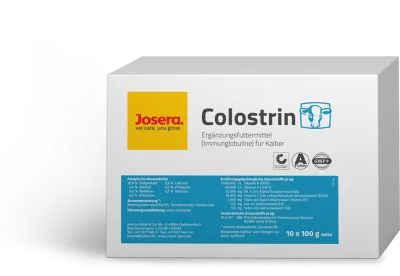
Colostrin
Complementary feed
Special product with immunoglobulins to strengthen the body‘s defenses
View Product

This article explains how to provide newborn calves with high-quality colostrum quickly and in sufficient quantities, assess its antibody content, maintain hygiene, and prepare for situations when the dam cannot provide an adequate supply.

Complementary feed
Special product with immunoglobulins to strengthen the body‘s defenses
An optimal start for dairy cows begins with optimal colostrum supply, preventing infection-related diarrhea from causing long-term damage. During this period, it is particularly important that newborn calves receive high-quality colostrum promptly and sufficiently.
Unlike humans, where babies receive antibodies from the mother via the placenta in the womb, the placenta of cows is impermeable to these vital protective substances. These antibodies are indispensable because, without them, the calf is unprotected against infections in its first weeks of life until it slowly builds its own immunity. In addition to its high energy content, colostrum primarily delivers a large quantity of vital antibodies from the mother's immune system. This includes both farm-specific antibodies and those the mother receives through vaccinations (e.g., from a protective vaccination against Rota, Corona, and E. Coli). Since these maternal antibodies can only pass through the calf's intestinal barrier in the first few hours of life, it is especially important to administer colostrum promptly after birth. This provides the calf with much better protection against diseases than its immune system could manage alone at this stage. Equally essential for a healthy start to life is the significantly higher content of trace elements and vitamins in colostrum compared to whole milk. For example, colostrum contains up to 33 times more zinc and five to eight times more vitamins!
Quick (within the first hours of life)
Quantity (3-4l)
Quality (good quality, see below)
In short, a timely and sufficient amount of high quality is important. If you adhere to this, almost nothing can go wrong. But how can you optimally fulfill all these points?
To determine the immunoglobulin content of colostrum as accurately as possible, you can choose between two simple, practical systems: a colostrometer and a refractometer.
This useful instrument is made of glass and resembles the hydrometer used in brewing to determine original gravity. It works on the principle of mass displacement, meaning it sinks to different depths in the colostrum depending on the mass per unit volume (i.e., how heavy a milliliter of colostrum is). To determine the amount of immunoglobulins in the colostrum, place a sample of the colostrum in a tall container and insert the colostrometer. The higher the antibody content in the fluid, the higher its mass weight, and the further the colostrometer will be pushed out of the colostrum sample. The colostrometer is equipped with a scale on which you can easily read the immunoglobulin content. Often, this scale simply consists of a red, yellow, and green area, which, following the traffic light principle, indicates whether the colostrum is suitable for optimal calf supply or not.
Colostrometers are calibrated to room temperature, which means that deviations can occur with very warm or very cold colostrum. Therefore, you should always allow enough time before measuring the immunoglobulin content to warm or cool the colostrum if necessary.

The refractometer has clear advantages over the colostrometer, although it is somewhat more expensive. It is not only more robust but also provides more accurate results that are independent of the sample temperature. This device utilizes the fact that different liquids refract incident light to varying degrees depending on their density. To use a refractometer to assess colostrum quality, you only need to drip a few drops of the fluid to be examined onto the instrument's cover glass, point it at a light source, and look through the lens. A digital refractometer saves more time as the desired value can be read immediately.
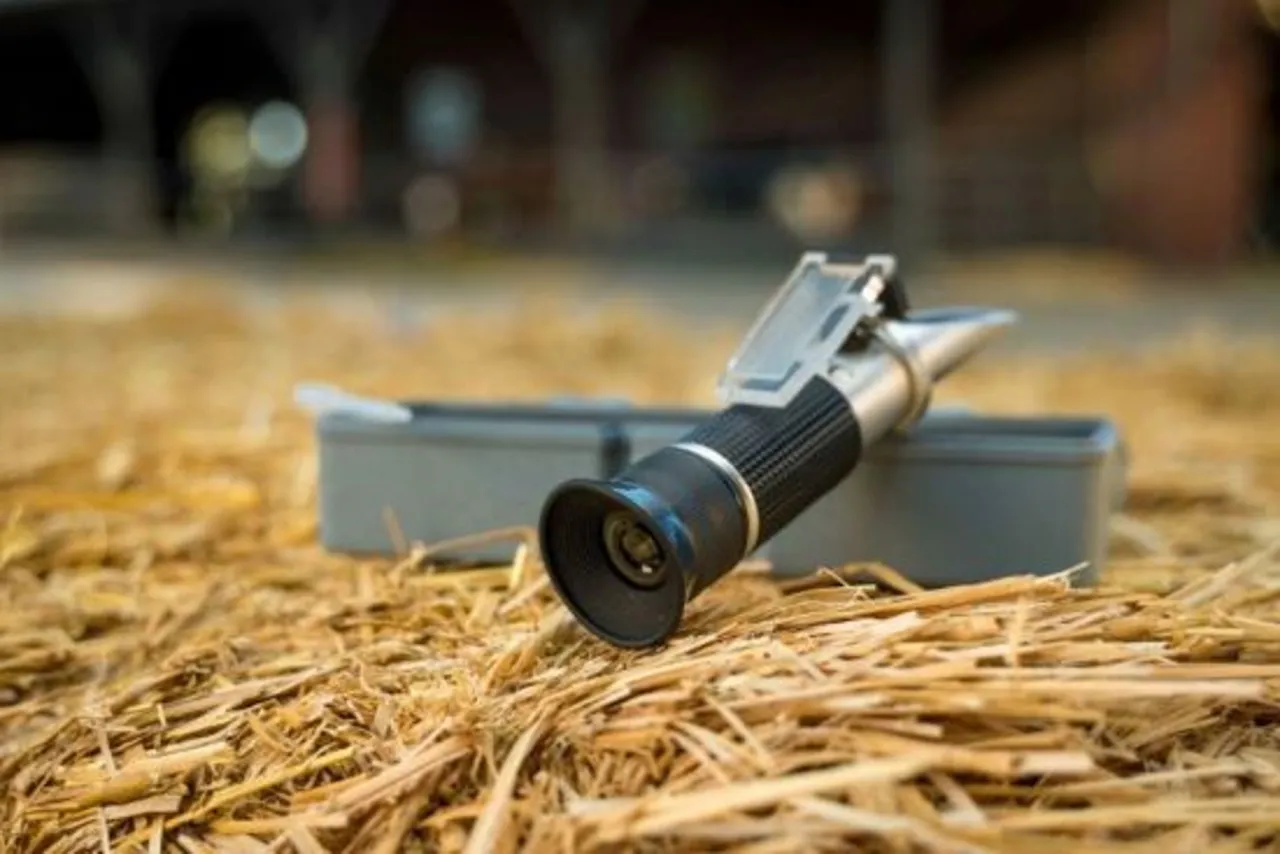
Source: Benedikt Rodens, Rückweiler - ELITE Online - www.bauernzeitung.at
Good colostrum contains 50 IgG/l.
The initial supply should be at least 150 IgG = 3 liters.
| Brix% | IgG/Liter |
| less than 20 | less than 25 |
| 20 to 22 | 25 to 50 |
| more than 22 | more than 50 |
Besides immunoglobulin content, other factors are, of course, important for colostrum quality. The amount of colostrum: the larger it is, the more likely it is to be "thin," i.e., not concentrated enough.
But even in colostrum collection, quality depends on correct timing: it is crucial that the first milking has the highest antibody concentrations, but the immunoglobulin content significantly reduces just 9 hours after birth. Therefore, it is important to collect colostrum from the first milking as soon as possible after birth to offer the calf optimal colostrum quality. Only a healthy udder with a correspondingly low cell count can guarantee this quality.
Possible contaminations should not be underestimated. The farmer is also crucial for improving colostrum quality. By ensuring good udder health in your animals and always working cleanly, you significantly contribute to colostrum providing a truly powerful start for your calves. Especially feeding buckets and teats should always be well cleaned and disinfected, as high germ counts can quickly accumulate there. The germ load on a healthy udder would be rather low for the calf, but in a feeding bucket, the number of germs can be 10,000 times higher, and on a teat, even up to 1,000,000 times. Therefore, good hygiene and clean working practices are crucial here to keep the pathogen load for calves as low as possible.
Furthermore, we recommend JOSERA Colostrin. It is a special product to strengthen the calves' immune defenses. It ensures a strong immune system and protects calves from infections. JOSERA Colostrin is a drinking supplement that covers the high demand for vitamins and trace elements in the first days of life and provides quickly available energy.


